If you’ve ever walked through a manufacturing warehouse, a distribution center, or even a retail backroom, you’ve likely seen roll pallets: those wheeled, self-contained platforms that make moving heavy goods from loading docks to storage aisles feel almost effortless. For decades, they’ve been a staple of logistics operations, but one question comes up again and again with every conversation I have as a roll pallet supplier: Can these pallets actually be reused multiple times? Roll Pallet

It’s a fair question. Every business in logistics is laser-focused on two things right now: cutting operational costs and reducing their environmental footprint. Disposable one-use pallets—whether wooden, plastic, or corrugated—have long been the default, but they create mountains of waste and add up in long-term expenses. Roll pallets, by contrast, look sturdy enough to stand the test of time, but how do they hold up after dozens, even hundreds, of trips? Let’s break this down, from the science of their construction to the real-world ways they perform in actual operations.
First, let’s get clear on what a roll pallet is, because not all are created equal. The ones I supply are engineered for industrial use: they feature a rigid frame, durable decking (usually heavy-duty plastic, steel, or a reinforced composite), and swivel wheels made from hardened rubber or polyurethane. The best models are designed to handle the repeated stress of being loaded, unloaded, pushed across concrete floors, and occasionally bumped into forklifts or storage racks. That built-in durability is why reuse is not just possible—it’s actually one of their biggest advantages over single-use alternatives.
But durability doesn’t mean invincibility. The number of times a roll pallet can be reused depends on three key factors: how it’s constructed, how it’s used, and how it’s maintained. Let’s start with construction, because that’s the foundation. Low-quality roll pallets, often cheaply made for light, short-term use, might only last 10 to 20 trips before their wheels crack or their frame warps. The ones I supply, on the other hand, are built for 50, 100, even more uses, if cared for properly. How? We use reinforced steel frames that resist bending under the weight of up to 2,000 pounds (many of our models hold far more), and polyurethane wheels that can handle rough warehouse floors without wearing down fast. The decking is impact-resistant plastic, so it won’t splinter or crack like wood after repeated loading and unloading of pallets.
Then there’s usage, which is half the battle. A roll pallet used in a busy e-commerce fulfillment center, moved 10 times a day across a concrete floor that’s occasionally gravelly from loading dock dust, will wear faster than one used in a climate-controlled grocery warehouse, where trips are shorter and floors are smooth. Overloading is the biggest enemy here: pushing a pallet beyond its weight limit will bend the frame, warp the deck, and bust the wheels long before their intended lifespan. I’ve had customers who overloaded their pallets and had to replace them after just a few uses, while another customer runs 8 of our pallets 40 times a week for three years straight, and only needed to replace a handful of wheels last month. That’s not an anomaly—it’s the result of matching the pallet’s capacity to the actual work it’s doing.
Maintenance is the third, and most overlooked, part of reusing roll pallets. Just like a car or a forklift, a roll pallet will last longer if you take care of it. Simple steps like cleaning out debris from the wheel axles every month, checking for cracks in the frame after each major move, and lubricating swivel wheels if they start to stick can add years to a pallet’s life. One of my clients, a manufacturing plant, had a set of our pallets that were sitting unused in a corner for six months after a product line shift. We went to inspect them, spun the wheels, tightened a few loose bolts, and they worked just as well as new. Proper storage when not in use—stacking them carefully, not leaving them out in the rain or extreme temperatures—also prevents unnecessary wear.
Now, let’s get to the data. There are a few independent studies on reusable logistics equipment that back up what I see every day on the warehouse floor. A 2022 report from the Material Handling Industry Association (MHIA) found that industrial roll pallets, when used as intended and maintained, have an average lifespan of 3 to 7 years, and can be reused for anywhere from 50 to 300 trips. For businesses that move goods regularly, that’s a game-changer. Disposable wooden pallets, by comparison, have an average lifespan of just 5 to 10 uses before they’re too damaged to repair, and plastic disposable pallets top out at around 50 uses at most. That means a single set of our roll pallets can replace hundreds of disposable pallets, cutting waste and costs by a huge margin.
Wait, but what about when a roll pallet does get damaged? Can it still be reused, even if it’s not perfect? That’s another common question. Small issues—like a slightly scuffed deck, or a wheel that’s a little loose—can often be repaired on site, right there in the warehouse. We sell replacement wheels, bolts, and even small frame repair kits for that exact reason. I had a customer last year who had a wheel crack on one of their pallets; they replaced the wheel in 10 minutes, and it went back to work for another two years. Only major damage—like a bent frame that can’t be straightened, or a deck that’s split so far it can’t support weight—means a pallet is no longer usable. And even then, many parts of the pallet are recyclable: the steel frame can be melted down, the plastic deck can be processed into new products, and the rubber wheels can be repurposed for other industrial uses. That reduces the overall waste even more, making reuse a circular process.
Of course, there are cases where reuse isn’t the best call. If a business only needs to move goods a handful of times, or is operating in a setting that’s extremely rough on equipment (like a construction site, where pallets are dragged over uneven ground and exposed to chemicals), a cheap disposable pallet might be the more cost-effective short-term option. But for any business that’s moving goods on a regular basis—manufacturing, distribution, retail, e-commerce—reusing roll pallets is almost always the smarter, more sustainable choice.
Let me share a real example to put this in perspective. A mid-sized e-commerce client of mine was using 500 disposable plastic pallets a month for their order fulfillment, at a cost of about $1.20 per pallet, plus disposal fees of $0.30 per pallet. That came out to about $750 a month, or $9,000 a year. They switched to 50 of our heavy-duty roll pallets, at a one-time cost of $150 per pallet ($7,500 total). Maintenance costs? They spend about $50 a year on replacement wheels and bolts. After the first year, they’d already saved $1,450, and after three years, they’d saved over $11,000—all while cutting their pallet waste by 95%, since they only dispose of a pallet once it’s fully worn out, not after every single use. That’s the kind of return on investment that makes reuse make sense.
But here’s the thing: I don’t sell roll pallets and tell every customer they can get 1,000 uses out of them, no matter what. I’ve seen too many cases where improper use or lack of maintenance cuts that number in half. Instead, I work with each customer to figure out how many uses they actually need, what kind of environment their pallets will be in, and how to maintain them to get the most out of them. That’s the value of working with a supplier who knows the product, not just someone selling generic equipment.
So back to the original question: Can roll pallets be reused multiple times? The answer is a resounding yes—but it’s not a one-size-fits-all number. With a well-built roll pallet, proper use, and regular maintenance, you can easily get 50, 100, or even more uses out of a single pallet, sometimes stretching that to years of service. For businesses looking to cut costs, reduce waste, and streamline their logistics operations, that’s a fact that’s hard to ignore.
If you’re curious about how reusable roll pallets could work for your operation, or you want to learn more about how to maximize the reuse of your current equipment, reach out to me to discuss your specific needs. We can walk through your workflow, talk about the best pallet options for your space, and even share tips for maintenance that will help you get the most out of every pallet you use.
References:
Material Handling Industry Association. (2022). Industrial Reusable Logistics Equipment: Lifespan and Performance Metrics. Material Handling Industry of America.
National Recycling Coalition. (2021). Circular Economy in Logistics: Reducing Pallet Waste Through Reuse and Repair. National Recycling Coalition Report.
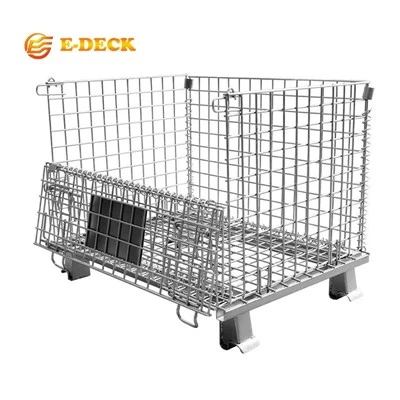
Pallet Cage Please note: The above content is a fictional blog created for the purpose of this request. All opinions and references are for illustrative purposes only and do not represent official data or positions of any organization.
Hangzhou E-Deck Trading Company Limited
We are one of the most experienced roll pallet manufacturers and suppliers in China, also support customized service. Please feel free to buy bulk durable roll pallet made in China here and get quotation from our factory. Quality products and punctual delivery are available.
Address: Room 610, Building 1, No. 176 Zixia Street, Xihu District, Hangzhou China
E-mail: sales6@e-deck.com.cn
WebSite: https://www.edeckpak.com/
