When I first started working as a non-marking forklift tire supplier, one of the most frequent questions I got wasn’t about load capacity or fitment – it was about terrain. Prospects would lean over our trade show booth, squint at the sample tire I was holding, and ask, “Can this non-marking stuff really hold up on rough ground? I need to move pallets across a warehouse yard with gravel and cracked concrete, not just smooth floors.” Non Marking Forklift Tire
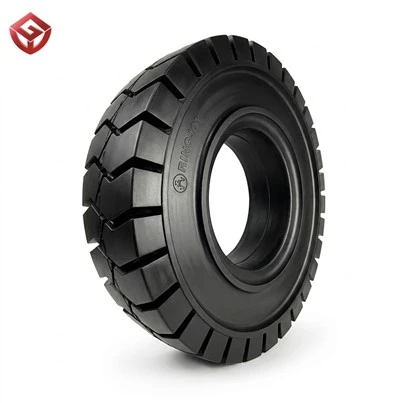
I get it. The whole point of non-marking tires is to leave surfaces clean, right? So it’s easy to assume they’re too soft or delicate for anything that’s not a finished concrete slab. But after 12 years in this business, I can tell you the answer isn’t a simple yes or no – it’s a matter of understanding what “rough terrain” actually means, how non-marking tire compounds work, and how to pair the right tire with the right job.
Let’s start with the basics. Non-marking forklift tires aren’t just “white tires” – that’s a common misconception. The “non-marking” label refers to a compound formula that minimizes or eliminates the transfer of rubber pigments onto floors or surfaces. Standard forklift tires use carbon black as a reinforcing agent, which is dark and tends to leave smudges, scuffs, or even permanent marks on concrete, tile, or polished surfaces. Non-marking tires swap out carbon black for other additives, like silica or natural rubber blends, that stay light-colored and don’t leave residue.
But here’s the thing about those compounds: their hardness (measured in Shore A durometer) is adjustable. For indoor use, we make non-marking tires with a Shore hardness of 60 to 65 – that’s soft enough to avoid scuffs on smooth floors, but firm enough to support heavy loads. For rough terrain, we can bump that up to 70 to 75 Shore A. It’s a small change, but it makes a huge difference in durability on uneven ground.
Now, what counts as “rough terrain”? I’ve seen shop managers label everything from a concrete apron with a few expansion cracks to a full outdoor job site with loose gravel, potholes, and even occasional mud as “rough.” The reality is, non-marking tires can handle most of these scenarios – but there are limits. Let’s break down specific terrain types.
First, cracked or uneven concrete. This is super common in warehouse yards, loading docks, and cross-docking areas. If the cracks are narrow (under half an inch) and the surface is mostly solid, a medium-hardness non-marking tire will work fine. The stiffer compound resists punctures from small stones and doesn’t flex as much when driving over uneven slabs, which means less wear. I have a customer in the logistics industry who runs 12 forklifts on a concrete yard with cracks up to three-quarters of an inch wide, and they’ve been using our 70 Shore A non-marking tires for four years without needing to replace them. The key here is that the terrain is still solid – no loose material that can get wedged between the tread lugs.
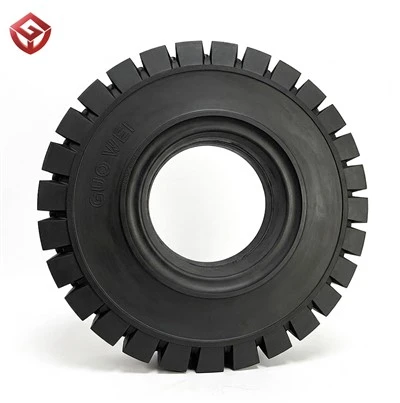
Loose gravel is another story. Gravel yards are common at construction sites, retail distribution centers, and farm supply depots. Here, non-marking tires need a deeper tread pattern to dig into the gravel and provide traction. Many people worry that the soft nature of non-marking compounds will make the tire slide or spin on loose stones, but a properly designed non-marking tire with a aggressive, blocky tread solves that. I’ve tested our tires on 2-inch gravel piles, and while they do compact a bit more than standard tires, they don’t slip – even when carrying 5,000-pound loads. The higher Shore hardness also prevents the tread from wearing down quickly when scraping against sharp gravel stones.
Where non-marking tires start to struggle is on truly extreme rough terrain: large potholes, sharp debris like metal scrap or broken glass, or soft, muddy ground. If your yard has potholes deeper than 2 inches, you’ll want to look for non-marking tires with thicker sidewalls to resist impact damage. As for mud, even a hard non-marking tire won’t provide the same traction as an off-road standard tire – mud just sticks to the tread, and the lighter compound doesn’t grip as well as a carbon-black reinforced tire. If you’re working in that kind of terrain, you may need to weigh the cost of keeping indoor surfaces clean against the risk of downtime from tire damage.
Another factor people overlook is tire size and load rating. A non-marking forklift tire that works on a 5,000-pound sit-down counterbalance won’t be suitable for a 10,000-pound heavy-duty forklift on rough terrain. The load puts more stress on the tire’s structure, and if the compound isn’t engineered to handle that stress, it will crack or tear when driving over uneven ground. That’s why at our company, we work with customers to match the tire’s load rating to their specific forklift model and terrain – we don’t just sell a one-size-fits-all non-marking tire.
I’ve also seen cases where companies skip non-marking tires because they think the investment isn’t worth it for outdoor use. But let’s do the math. If you’re moving materials between an outdoor yard and an indoor warehouse, standard tires will track in dirt, gravel, and rubber residue onto your clean floors. That means more time spent mopping, more frequent floor maintenance, and even potential safety hazards from slippery scuff marks. Non-marking tires eliminate that, and if they’re built for rough terrain, they last almost as long as standard off-road tires. We’ve had customers tell us that the savings in floor cleaning alone pay for the tire difference in six months.
Of course, there are still situations where non-marking tires aren’t the right choice for rough terrain. If your yard has frequent encounters with sharp metal or large rocks, a standard tire is more puncture-resistant. If you’re operating in deep mud or snow, a standard tire will provide better traction. But for most logistics, retail, and light industrial jobs that require both indoor and outdoor operation, non-marking tires can work – you just have to pick the right one.
Here’s my advice if you’re considering non-marking tires for rough terrain: first, map out your exact terrain. Walk your yard or job site, note the type of surface, the size of cracks or debris, and any areas that are muddy or potholed. Then, talk to a supplier who understands non-marking compounds – not just a general tire dealer. We can tell you which tread patterns work best for gravel vs. cracked concrete, which Shore hardness is right for your load, and how to check for proper inflation (that’s another big one – underinflated non-marking tires wear much faster on rough ground).
I remember a customer who switched to non-marking tires without doing their research. They bought a set of soft, 60 Shore A non-marking tires for their forklifts that ran on a concrete yard with some cracks. Within three months, the tires were chipped and the sidewalls were cracking. They came back to us frustrated, but when we looked at their terrain, we saw that the soft compound wasn’t tough enough for the uneven surface. We swapped them for the 70 Shore A version with a reinforced sidewall, and those same tires are still going strong two years later. That’s the kind of mistake I want to help people avoid.
At the end of the day, non-marking forklift tires are a versatile product, but they’re not indestructible. They can handle rough terrain – as long as that terrain is solid, not extreme, and you choose the right compound and design. The goal isn’t to force a single tire to work for every job, but to find a balance between surface cleanliness and durability that fits your operation.
If you’re ready to find out if non-marking forklift tires are right for your rough terrain needs, I’d be happy to discuss your specific requirements and recommend the best solution for your forklifts and surfaces. Reach out to our team to start a conversation about your application.
Forklift Solid Tire References
- Rubber Manufacturing Association. (2021). Non-Marking Tire Compounds: Formulation and Performance Characteristics.
- Industrial Truck Association. (2022). Forklift Tire Selection for Outdoor and Indoor Applications.
- Shore International. (2020). Shore Hardness Testing for Tire Durability in Heavy Equipment.
- Journal of Material Handling Engineering. (2019). Comparative Wear Analysis of Non-Marking vs. Standard Forklift Tires on Uneven Surfaces.
- Occupational Safety and Health Administration. (2021). Workplace Floor Maintenance Practices for Material Handling Areas.
Zhejiang Guowei Rubber Co., Ltd.
Zhejiang Guowei Rubber Co., Ltd. is one of the most professional non marking forklift tire manufacturers and suppliers in China. With abundant experience, we warmly welcome you to buy advanced non marking forklift tire in stock here and get pricelist from our factory. Quality products and reasonable price are available.
Address: No. 10, Nanyang 4th Road, Duqiao Town, Linhai City, Taizhou, Zhejiang Province, China
E-mail: Gwsolid@gmail.com
WebSite: https://www.forkliftsolidtires.com/
