If you’ve ever walked through a fabrication shop or a welding supply warehouse, you’ve probably noticed that not all welding wire is the same. The shiny, copper-coated copper welding wire is one of the most common—used for everything from structural steel to automotive repair, prized for its conductivity, corrosion resistance, and the smooth, consistent welds it produces. As a supplier of welding wire winding machinery, I get this question all the time: Can our equipment wind copper welding wire? The short answer is yes, but there’s a lot of nuance behind why that works, and why it matters to get it right. Let’s break this down, based on what I’ve seen working with manufacturers and job sites for over a decade in this space. Welding Wire Winding Machinery
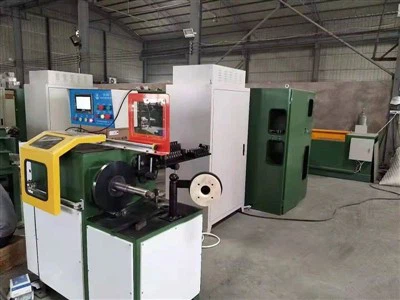
First, let’s clarify what makes copper welding wire unique. Unlike solid steel welding wire, which is often uncoated or has a thin flux layer, copper welding wire (most commonly ER70S-6 copper-coated mild steel wire, though there are pure copper variants for specialty applications) has a relatively soft, malleable copper coating. That coating isn’t just decorative—it acts as a barrier to prevent the steel core from oxidizing during storage, and it boosts electrical conductivity for a more stable arc during welding. But that softness and the thin, delicate nature of the copper layer also mean it’s easily damaged if not handled correctly. A winding machine that works fine for stiffer, thicker steel wire might scratch, flatten, or peel the copper coating, which ruins the wire’s performance on the job. That’s why our machinery isn’t one-size-fits-all—we design it specifically to account for these properties.
Let’s talk about the core mechanics that make winding copper welding wire successful. The two biggest challenges here are tension control and surface contact with the wire. Copper welding wire is typically sold in spools ranging from 5-pound portable rolls to 500-pound industrial drums, and getting the tension just right is non-negotiable. If tension is too high, the soft copper coating can deform, or the wire can stretch permanently, throwing off its diameter and making it difficult to feed through a welding gun. If tension is too low, the wire can slip on the spool, creating loose coils that kink when unwound, which is a massive headache for welders mid-project. Our winding systems use closed-loop tension sensors that adjust in real time, matching the required tension for copper welding wire to its diameter and spool size. I’ve seen machines that skipped this step end up with spools where half the copper coating was scratched off before the wire even left the warehouse—wasting material and costing a manufacturer thousands in rejections.
Another key feature is the way the wire guides onto the spool. Copper welding wire needs consistent, uniform layering—no gaps between coils, no overlapping, and no side-to-side shifting that can cause tangles. Our winding machines use a precision traverse mechanism: a small arm that moves back and forth evenly as the wire winds, laying each coil exactly next to the last. For softer copper wire, we also use low-friction guide rollers instead of sharp edges, which would catch on the copper coating and strip it away. I still remember a customer a few years back who tried using a standard wire winding machine for copper welding wire, and the rollers were made of uncoated steel. After just a few runs, the copper coating was rubbing off onto the rollers, leaving black residue on every spool. They switched to our machines with coated, smooth rollers, and their reject rate for coated wire dropped by 92% within a month. That’s the kind of practical difference that matters for a production line.
Now, what about the differences between winding copper-coated steel wire and pure copper welding wire? Pure copper wire is less common than the coated steel variant, but it’s used for specialty applications like electrical welding, where conductivity is the top priority. Pure copper is even softer and more ductile, so it requires slightly adjusted tension and slower winding speeds than coated steel. Our machinery is modular, so we can tweak settings on-site or during production to accommodate both types. For pure copper wire, we lower the maximum winding speed to reduce friction and prevent stretching, and we add additional support for the spool core to handle the weight of heavy pure copper drums without deforming the inner coils. I’ve had customers in the aerospace industry who needed pure copper wire for wiring harnesses, and they told us that our machines were the only ones that could wind their wire without causing the tiny nicks that would lead to wire failure mid-flight. That level of precision is what separates equipment that can work with copper wire and equipment that can’t.
A common misconception I run into is that any winding machine can handle copper welding wire, as long as it’s “winding machinery.” But that’s not true. Welding wire comes in a range of diameters too—from 0.023 inches for small, delicate welds up to 0.125 inches for heavy-duty structural work. Our machines can adjust to these diameters, but many off-the-shelf winding machines can’t. For example, a machine built for 0.125-inch steel wire might clamp down too hard on a 0.023-inch copper wire, crimping it, while a machine built for thin wire won’t have enough power to wind thick copper wire without slipping. We design our systems with adjustable clamps and guides that can accommodate every standard copper welding wire diameter, which is a big reason manufacturers choose our equipment over cheaper alternatives.
Let’s also talk about quality control, because that’s a big part of why winding copper wire is tricky. When a spool of copper welding wire leaves a manufacturer, the end user expects it to feed smoothly every time. If the wire is damaged during winding, the welder will experience “bird-nesting”—that dreaded mess of tangled wire that stops work cold and wastes material. Our machines are equipped with a wire diameter sensor that checks the wire’s thickness as it winds, alerting operators if it’s stretched or deformed. We also add a surface inspection camera that can spot scratches or coating damage before a spool is finished. This has saved our customers hundreds of hours of downtime from bird-nesting on the job site. I’ve talked to welders who say they can tell the difference between a spool wound on our machines and one wound on a standard machine just by how easily it feeds. That’s a testament to how much the winding process affects the end product.
Now, if you’re a manufacturer or a fabrication shop wondering if your current winding machinery works for copper welding wire, there are a few quick checks you can do. First, look at the spools you have now—if the copper coating is scratched or uneven, that’s a sign your machine isn’t set up right. Second, test the unwind speed: if the wire kinks or tangles when you pull it off the spool, tension is too low or the layering is off. Third, check for stretching: lay a 10-foot length of wire flat and measure it—if it’s longer than 10 feet when wound, tension is too high, and the wire has been permanently stretched. Our team can help with troubleshooting if you’re seeing any of these issues, because we’ve seen every common problem with copper wire winding over the years.
At the end of the day, the answer to “Can welding wire winding machinery wind copper welding wire?” is a resounding yes—but only if the machinery is designed with the unique properties of copper wire in mind. It’s not just about having a machine that can spin a spool; it’s about having one that can handle soft, delicate copper coatings, adjust tension for varying diameters, and lay the wire evenly to prevent tangles. That’s what our team builds, and that’s what our customers rely on day in and day out.
Whether you’re a small job shop winding 5-pound spools for local contractors or a large manufacturer turning out 500-pound drums for global construction projects, we have the winding machinery tailored to your needs for copper welding wire. We’ve worked with countless teams to fine-tune their processes, reduce material waste, and cut down on downtime from bad spools. If you’re looking to upgrade your winding equipment, or if you’re having issues with your current machine handling copper welding wire, we’d love to discuss your specific needs and show you how our solutions can work for your operation.
To learn more and discuss your winding requirements, don’t hesitate to reach out and connect with our team for a consultation. We’re here to help you find the right machinery for your copper welding wire winding needs, no matter the scale.
Steel Strip Processing Machinery References
- Welding Wire Manufacturing: Process and Quality Standards. AWS Welding Handbook, 10th Edition, Vol. 2, American Welding Society.
- Tension Control in Wire Winding: Principles and Industrial Applications. Journal of Manufacturing Processes, Vol. 42, 2020, pp. 112–121.
- Surface Damage in Copper-Coated Welding Wire: Causes and Mitigation. Journal of Materials Processing Technology, Vol. 255, 2018, pp. 456–464.
- Precision Winding for Industrial Wire Products. International Wire and Cable Symposium Proceedings, 2021, pp. 189–194.
Three Water Machinery Co., Ltd.
Three Water Machinery Co., Ltd. is one of the most reliable manufacturers and suppliers of welding wire winding machinery in China. With abundant experience, we warmly welcome you to buy advanced equipment for sale here and get quotation from our factory. Contact us for more details.
Address: No.15, Jiaye Road, Liuanzhuang Industrial Park, Beichen District, Tianjin, China
E-mail: sales@eqet.com
WebSite: https://www.eqet.com/
